Hot Springs of the Damned

Overcoming fear and loathing in an ancient place of healing

Monday. Late March, the first real, warm breath of spring morning licking the Ouachita ridges like a lover who might still turn cold by nightfall. I sputtered into Hot Springs, Arkansas, in my dented Chevy pickup smelling like cigarettes and a decade of regret, my joints stiff from the long haul out of the frozen Midwest where my life had finally shit the bed for good. Thirty-eight years old. A thousand rejected poems and three unpublished novels, a divorce that took half of what little I had left, and a liver that felt like it had been pickled in a jar of Jameson. The bottle had been my co-author for as long as I could remember. For years I’d run on whiskey and Marlboro smoke til 3 a.m., typing my blasphemies onto the pages that my old Smith-Corona clutched until the words turned to static. Sobriety? I laughed defiantly at the word once. Now it was the only thing left that scared me more than an empty page.
I’d come here on a whim, urged by the last twitch of delirium-induced instinct to test the renewing magic of thermal springs and Bathhouse Row. The stories I’d read of gangsters and the crippled soaking to cure their sins and wounds flooded my mind. If they could rinse away their demons and god-handed curses in water that bubbled up from the earth at 143 degrees, maybe I could too. “Heal your bones and soul,” some quack online had said, “Warm the marrow. Escape the aching of your past and be bathed free of your ills.”
Bullshit, I figured.
Water doesn’t stand a chance to fix a man who’s spent his life chasing the dragons of dependency and relevance. But the first blue-skied days of southern spring gleamed with merciful allure, and my cold and empty apartment in Chicago had started to feel like a concrete coffin.
So, fuck it, here I was, pulling up to the Arlington Resort Hotel & Spa, that grand old bitch on Central Avenue, built in 1925 after the original burned, her towers rising like a cathedral for the damned.
The lobby welcomed like a fever dream: chandeliers of crystal coated in dust, sockets where others once hung now just dangling wires and burnt out bulbs; decades-old leather chairs and marble floors worn but polished to a gritty shine like they were buffed with spittoon juice. I’d read that Al Capone himself had claimed the entire fourth floor here once, holing up in room 443 with its secret closet tunnel to the bathhouses, dodging feds and rivals while he tried to soak away his syphilis in the calcium-rich mineral springs. Owney Madden, Lucky Luciano, Bugs Moran—they all came. Illegal casinos hummed in back rooms and beneath the streets, tunnels ran for bootlegging whiskey and quick escapes, the whole town a Southern Vegas before the Vegas that defined fear and loathing was invented.
In short sum—a layered and metamorphic place with opulence on its surface, murky, earthy rot underneath, and cracks everywhere. I loved it and felt cozy already. With no reason for anonymity, I checked in under my real name and took a room looking into the mountains with no minibar. I stared at the empty fridge like it was mocking me.
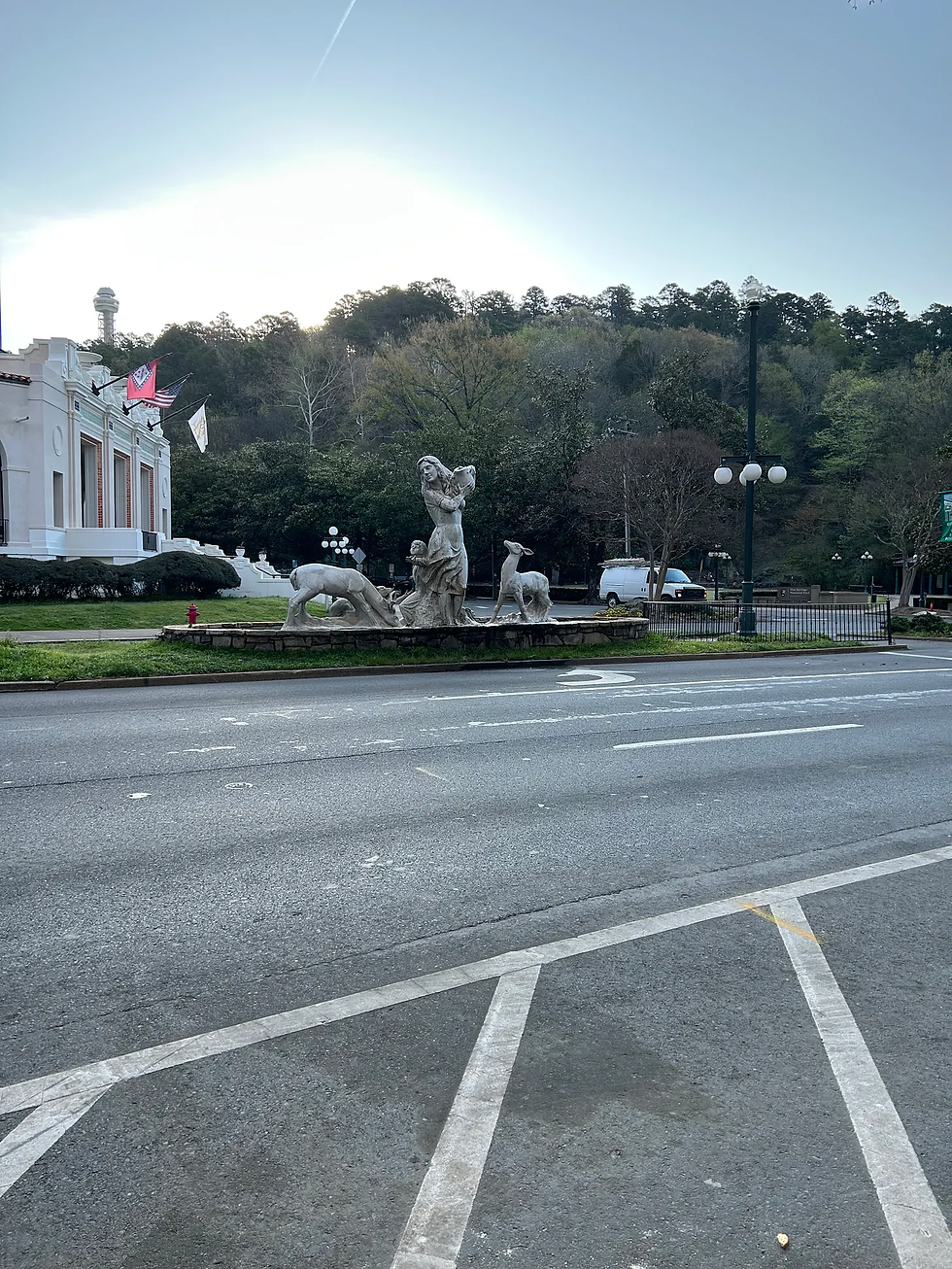
After unpacking what little I brought, I took a walk down Bathhouse Row. Spanish Colonial and Renaissance style relics lined up like sentinels along the promenade, steam venting from the fountains and spigots in lazy plumes. Fordyce was a museum now, all preserved tile and history plaques for gawking tourists to take photos of. Superior had been retrofitted into a yuppie-filled micro-brewery and restaurant. Quapaw looked the part but catered to a more modern spa-seeking crowd. Buckstaff was the only one that still ran the real deal—whirlpool mineral baths, steam cabinets, and needle showers that pounded you like a hangover cure.

The dichotomy slapped me hard: pompous selfie-takers in designer sneakers trying to ease away the stress of their lives of influence, while a few blocks over, pawn shops and check-cashing joints bled into rundown motels and boarded-up restaurants where a few beggars stared vacantly like they’d been here since Capone’s day and never left.
Poverty and polish, new construction and abandoned decay—all braided together under the same warm sun. The Ouachitas rose green with newly budding leaves in the distance, ancient as spring’s hope and all the cycles of renewal that time always oversees.
I put off the baths to fill my empty gut and walked into a place called The Pancake Shop off Central. My waitress—Jane, seventy-something, hair like steel wool, eyes sharp and all-catching. My order—ham steak, scrambled eggs, and a combo of buckwheat pancakes and black coffee that tasted sweeter than I’d expected. She poured my refill and didn’t blink at the tremor in my hands. “You here for the waters, dear?” she asked, voice like an Ozark mama bear who’d just drank a jar of honey. I nodded, skepticism apparent despite my attempt to mask it. “They helped me once,” she said, sliding into the booth uninvited. “Came here broke and broken thirty years back. Car wreck nearly took my leg off. Soaked every day for a year. Can’t say if it’s a cure by itself. But something shifted and I felt good enough to have ‘em take the bolts and screws out.”

Oblivious to her other tables, she continued, “I started feeding a one-winged vulture out back of my house. Found him half-dead sittin’ in the woods, wing mangled by a shotgun blast I guess. Nursed him back with scraps and patience and mountain valley water. Named him Adonis. Took a while, but he flies crooked now, just like I walk, but, like I said, he flies. A movie-man even came ‘round and made a documentary about him.”
She talked for an hour about her journey while another young waitress attended her tables and glanced at me annoyingly. Bright-eyed, without interjection, Jane recounted nights she spent screaming at the moon and days in the bathhouse steam where the heat peeled away the pain. Adonis greeted her on the porch rail every dawn, a ragged black reminder to keep enduring. As we parted, she told me about the horses she liked in the upcoming Arkansas Derby. “Always bet the ones that have a name that makes ya smile.”
I left her a ten on a fifteen dollar check and walked out feeling raw, like she’d scraped the scab off my own wound with sandpaper. My doubts ran in a torrent. Water was water. My hurt was a malignant boulder no spring could erode. Exhausted and nerves jittering from her sermon and the alcohol withdrawals, I returned to the room and tossed and turned through eighteen hours of cold sweats and nightmares of myself having lost one arm and grown a vulture’s head.

Tuesday. I crawled from bed wearing the same reeking clothes I arrived in and staggered to Buckstaff. Once in, I stripped down in the old wooden stalls, slipped into the whirlpool. The mineral water hit like molten lead—hot, buoyant, smelling noticeably of rock and iron. Attendants in white coats moved like priests: hot towels, cold plunges, needle showers that drilled into your skull. I floated like a boiled frog, eyes closed, and for the first time in years the noise in my head quieted. Not healed or erased. Just... blunted and hazy; quieter. The past flickered like an old cinema reel instead of the high definition it normally returned in. I still saw my ex-wife’s face, the same endless stream of rejection letters, the night I punched a hole in the wall and bled it onto my manuscripts and called it “research.” But, in this masochistic gauntlet, they all seemed more distant and unthreatening.
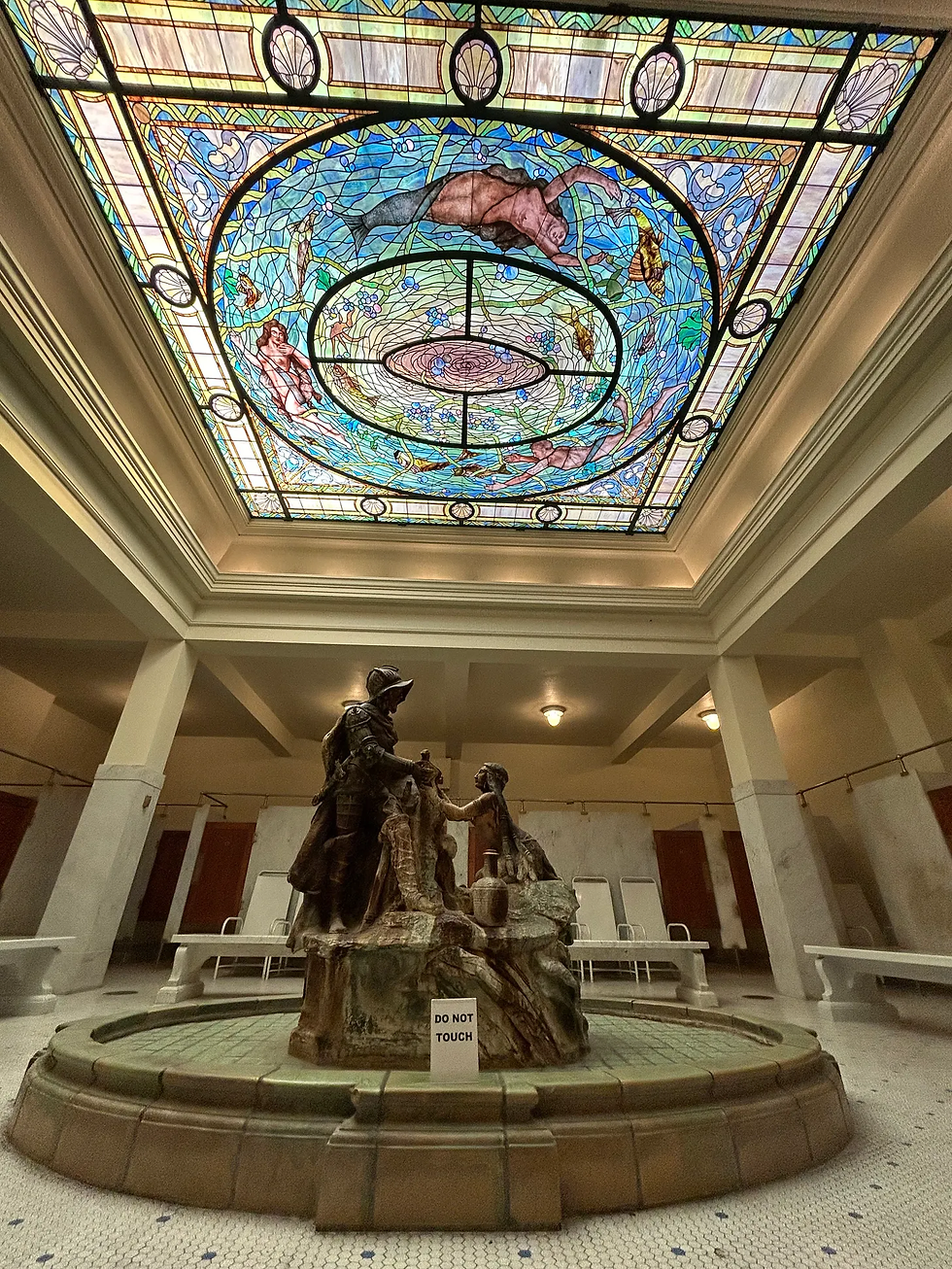
Out in the streets afterward, I wandered the Grand Promenade, the old, well-laid herringbone brick path where gangsters once strolled arm-in-arm with their dames. Historic markers everywhere: this was where the Ohio Club ran slots and poker till the feds shut it all down in ’67. A history of violence—shootouts in the alleys, bodies in the springs—now replaced by bachelorette parties, joggers, and gimpy retirees.
At noon, I took a drive north to walk the Caddo Bend Trail and turned up Fox Pass, a winding cut through the hills maybe four miles from town. Single-wides with heaping junkyards, crumbling homes being swallowed by jingweeds, simple cabins tucked in the woods. Lost, I turned on a dirt road and stumbled upon an idyllic little homesite and shack hidden behind oaks and boulders. Smoke rose from a kiln. A pretty garden laid in early stages of preparation. I was promptly greeted by a man in his seventies who looked ten years younger, beard like a prophet, clay up to his elbows. His name was Jim. Local potter and philosopher, the former deemed by himself, the latter by a friend who immortalized him on a cartoonish poster he’d made of him that hung proudly in his shop.
“Looking for a good whiskey mug?” he grinned, eyeing me up and handing me a rough one still warm. We sat on stumps outside his workshop while I marveled at the shelves of bowls and vases in various states of finish and glaze and etched with mountains and ravens and dragonflies. His work was astonishing and of a quality I’d never seen or cared to look for. “This clay comes from the same earth as the springs,” he said. “Been digging it for fifty years. Shape and fire it right, it holds water forever. Do it wrong, it cracks and leaks. Same as a man, I suppose.”
We talked a while and I told him more about my life than I’d told anyone since my father died and my marriage burned. He replied in kind.
His life: Former chemistry teacher, restless spirit, found the hills and the wheel by accident and never quit. “The springs don’t heal you,” he said, kneading clay as he spoke. “They remind you the earth’s been through worse—volcanoes, floods, ice ages—and it’s still pumping things up from the core. If you wanna keep your heart thumping you gotta be willing to let it all in, accept it, and yourself, bad parts and all.” I bought a mug for twenty bucks and drove on toward the trail feeling like a gaping hole had been torn in my armor.
Witnessing a man who’d found his craft and mastered it with humility—while living his life fully and on his own terms—is gutting in the most beautiful way.

On the way further, I took another wrong turn that led me deeper into the hills toward Jessieville, where the Coleman mines cut into the ridges like gouges left by some ancient civilization who lost something more valuable than time in the earth. Dust hung thick in the air from the quartz diggings, but a wild woman in overalls and a battered hard hat was working the edge of an outcrop nearby her roadside shop, her face deep-lined like the Ouachitas themselves. She looked up from her shovel, eyes fierce as a cornered bobcat. “You ain’t here for the pretty rocks, are ya?” she rasped, wiping sweat. “Name’s Ruth”, she said; born in these hollows and working the mines since she was tall enough to swing a pick.
I told her why I’d come and how turned around I was in the present moment. She laughed, a sound like fast water in a dry creek bed which broke into rapid fire speech. “Springs saved me once, too. Ten years old, some bastard from the next county jumped me on the trail home. Left me for dead. Mama dragged me to the Buckstaff every day for a month after. Water didn’t magic the bruises and memories away, but it put something clean in me. I learned to fight back with these hands. Healing don’t come from the heat—it’s the fight you bring to it.” She picked up a chunk of the stone at her feet, translucent gray shot through with quartz. “This here’s novaculite—Arkansas stone. Rare as hen’s teeth. Only forms in these ridges, Devonian rock from three hundred million years back when the mountains was born. Indians chipped arrowheads and blades from it ten thousand years before white men showed up. Best whetstone on earth, put an edge on like nothing else.” She handed me a palm-sized slab, smooth as silk. I bought three for twenty bucks. Figured it’d be good for the old pocketknife I carried, and maybe could hone whatever was left of my writing life. She waved me off with a grin. “Make it sharp and then soak it. Mind don’t heal till it wants to.”

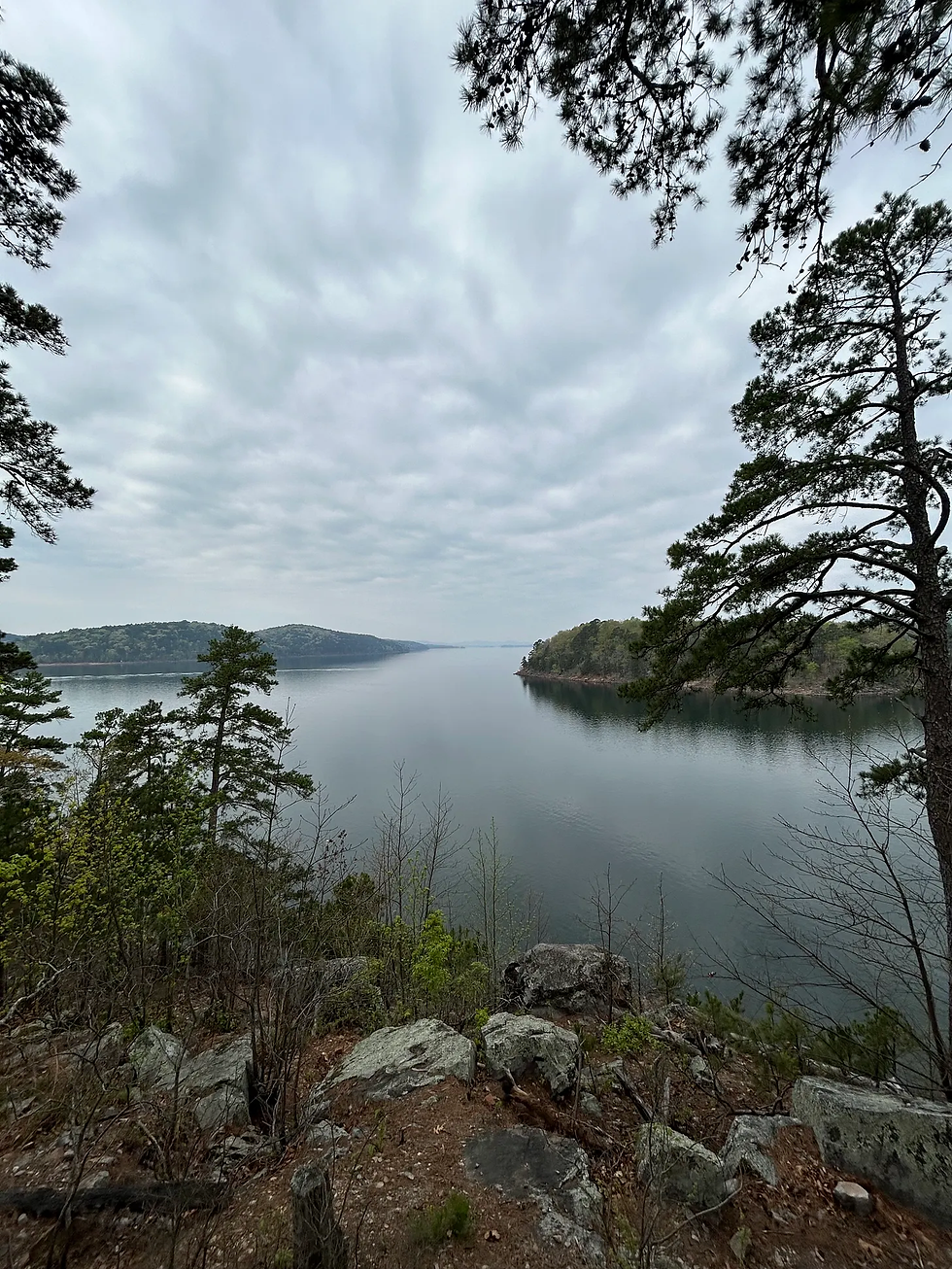
With her guidance having corrected my direction, I found my way to the Caddo Bend Trail. With just a green glass one-liter bottle of Mountain Valley Spring water in hand, I hit the path and wound along the lake edge through a forest dotted with blooming dogwoods. The air was thicker here, heavy with the renewing scent of damp earth and mineral springs seeping from the banks. I walked slowly, listening to the babble of water running toward the lake. The trail reminded me of how small my own upheaval was against the slow, patient carving of the hills. I stood for a while on a rocky overlook mid-way, the lake in gentle waves reflecting the clouds. In the silence, I felt the weight of centuries pressing gently against my chest. It wasn’t a fearful pressure. Just a reminder that the land and waters carried their own deep memories and quiet will. After I’d finished, I filled my bottle from the second of the Three Sisters Springs, then began my trek back to town.
The whole drive back, I ran my thumb methodically over the dull blade of my knife, remembering how my father once took such pride in readying it. I remembered how sharp it’d been before it’d been handed down and neglected by me. I looked out at the once jagged mountains that were softened by time and turning gold in the late light, Ouachita National Forest stretching endless—pines and ridges, trails snaking up Hot Springs Mountain like veins. A pair of turkey vultures wheeled overhead, black wings catching the last sun, and as I passed the diner and neared the Arlington, I envisioned Adonis again.
Wednesday. Feeling lighter, I started another hike at sun-up. This time I began at the Fordyce and climbed the steps behind it to the Hot Springs Mountain trails. The air was crisp but warming, first real spring—birds exploding in the canopy, blue phlox and coreopsis pushing through last year’s rot in ground heated from deep below. A white-tailed deer ghosted across the path twenty yards ahead, ears twitching, vanishing into the laurel like it had never been there. Songbirds filled the air with a racket that felt alive in a way Chicago never had. The trail swooped and switchbacked at a calm grade, but I took the steeper shortcut route up to the mountain tower overlook where the whole valley spread below, Bathhouse Row tiny as toy houses on some Ozarkian Monopoly board, Oaklawn’s racetrack a green oval in the distance. Breathtaking. Rolling mountains stretched as far as I could see, all with secret creeks and springs gurgling with that same mythic water rushing deep beneath my boots.
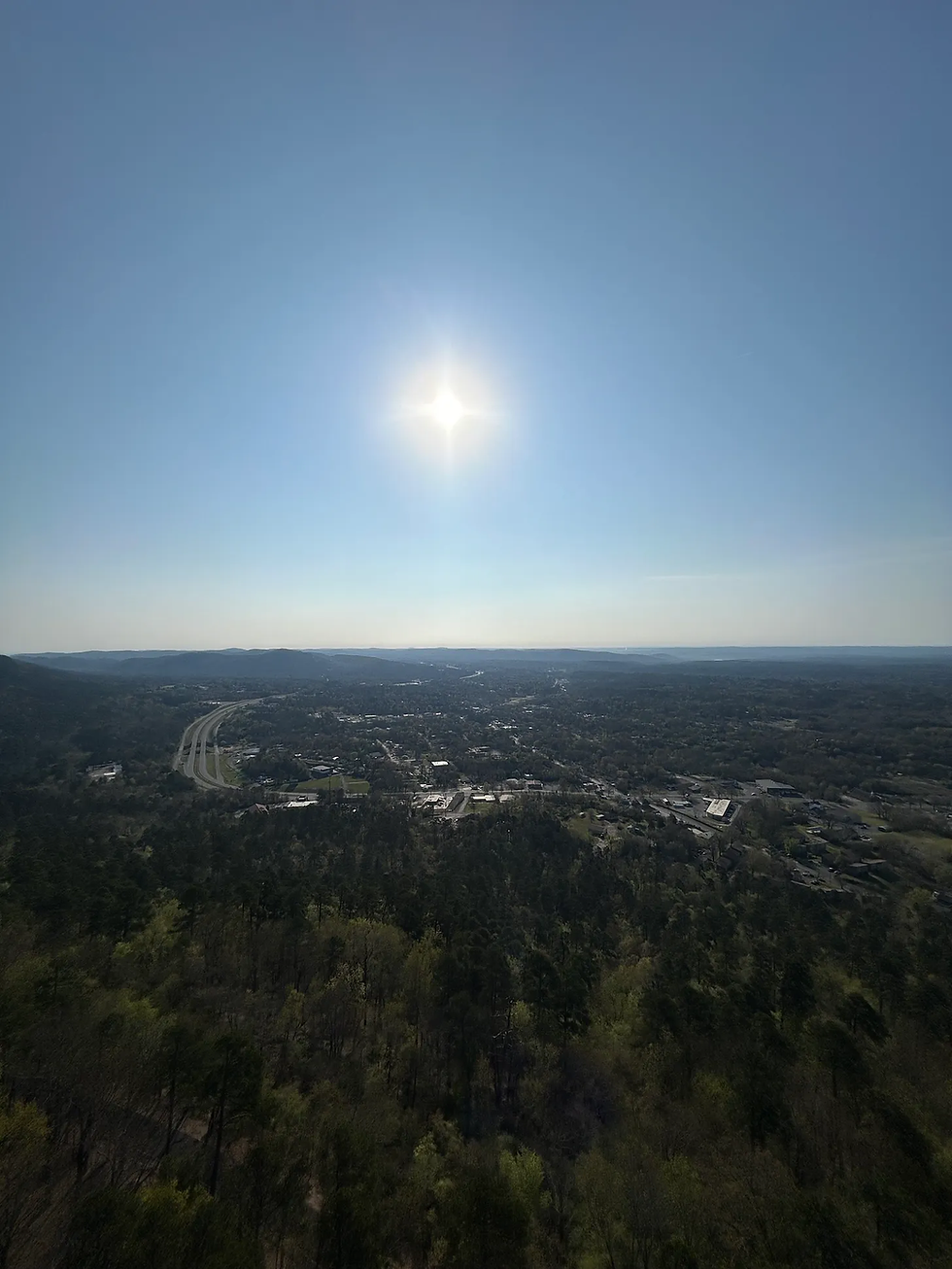
Before the hike down, I sat on a rock and let the wind hit me. No phone. No notebook. Just the vast green indifference of the 1.8 million acres of national forest wrapping the park like a mother holding a tormented child forever inflicted with growing pains. Poverty down in the gulleys and edges—mobile homes with tarp roofs, rust-eaten cars on blocks. Grandeur up here in the views the rich pay to see.
The city’s violent history whispered in the wind: Capone’s moonshine ran through these passes, bodies dumped in the mountain caves and ravines. But the springs kept bubbling, unperturbed. A red-tailed hawk screamed overhead, circling slow, and something in me shook loose and urged me back down to the Row and another baptismal session at the Buckstaff.
That night back at the hotel bar. I felt the pull of the bottle like an old bitch of a mistress but her voice was less seductive than usual. I resisted without much effort and stuck to club soda, ate a steak, and returned to the room, unboxed my typewriter, and pounded out a half-dozen pages instead: raw, passionate, sober shit about band-aids on bullet wounds and the poignant fissures that exist in masonry and men and memories that never really can be mended fully—but somehow must be trusted not to collapse.

Thursday. Outside Buckstaff after another morning session, nursing a coffee on a rocking chair, I met Steven. Eccentric, gap-toothed traveler who returned here every spring from Illinois, sixty-ish, wild gray hair. His t-shirt read Masterbaiters Bait & Tackle Shop, which is indeed a real place I later found. He was a history buff and rambled with the energy of a lifelong bullshitter and we hit it off effortlessly.
“Dad gambled here in the ’40s,” he said, lighting a Newport. “Mob days. Capone’s crew ran the tables at the Southern Club. Dad won big once, lost bigger. Came home with a scar and stories that ruined him.” He invited me to walk the Row with him and pointed out the old tunnel entrances, bricked up now. “This town’s always been halfway to healing, halfways to hell,” he laughed. “Dad said the waters cured his gout but not his soul. He was here on the run from his own ghosts—widower, restless, kinda like you.”
As we strolled, Steven gestured toward the ridges and the steaming vents. “Long before any of us, this was the Valley of the Vapors,” he said. “Caddo, Quapaw, Choctaw, and others came for thousands of years—maybe more—to be purified in the sacred waters. It was neutral ground, a place of truce where warring tribes laid down weapons and shared the healing steam of the Great Spirit’s breath. No blood spilled here, no sir, at least not in the old stories.” He paused, eyes narrowing.
“Then the white world crashed in. Fucked it up with greed like we always do. Civil War tore the state apart—Hot Springs even served as temporary state capital in 1862 when Little Rock was threatened. Governor moved the records here for a couple months. Skirmishes flared in the hills, guerrilla bands loyal to both sides, men arrested for refusing loyalty oaths. The springs kept spewin’ through it all, no allegiance to flags and bullets.” We swapped lies about the road and stories about our hurt till dusk on the Arlington steps.

As I bid Steven farewell, anxious to return to my room and hammer out a few more good pages, the contrast struck me again: a Range Rover was idling outside the hotel while a homeless vet in his wheelchair was panhandling by the fountain with his two sad-eyed dogs. Healing waters steaming up from the earth, heavy sadness falling from his breath. A groundhog waddled across the lawn nearby, fat and unafraid. He crawled up the edge of the fountain and jumped in for a bath and a smile curled into my cheeks.
Friday. I woke and bathed a final time at Buckstaff then rolled my truck into the parking lot at Oaklawn around noon. The racetrack and casino complex was pulsing in fervor on the edge of town. Kentucky Derby prep—the Arkansas Derby tomorrow, big dreams, big money, bigger egos. I wandered the grounds, the air thick with fresh horse shit and hope. Met an owner named Clayton from Kentucky in the paddock area, a tall man in designer boots and a crisp Stetson, horse named Two Dollar Eddie in the stall behind him. “Nasty little sumbitch,” he grinned with an impossibly wide smile, “ain’t much to look at but he runs like the devil’s chasing him and he owes him a two-dollar-bill. Hence the name. Narrow victory tomorrow, mark my words.” We talked bloodlines and bad bets and all the things that go into naming a good horse.
Later, at the rail, I bumped into a woman in faded Levi’s and a pink-ribboned derby hat, eyes red from the dusty track and the half-dozen mint juleps she’d had with lunch. Lila, she said—came here three years back fresh off a split that hit her by surprise like a freight train. Husband gone with a note on the kitchen table, no warning. “Came here same as you, I guess,” she told me, voice steady but cracked at the edges. “Soak the hurt out. Have some fun. Find something worth holding onto.”
Turned out she’d met a cowboy in town for the races, a rough-handed, bull-hearted rancher from Texas with a trailer and a grin that didn’t quit. They’d spent the week talking under the grandstand lights, him sharing his own busted marriage, her letting the springs and the horses and the man’s easy laugh work on her raw spots. “Water didn’t do it alone,” she said, watching the horses warm up. “I had to let go first before I could let the good in.” She touched my arm as I turned to leave, like a sister in the trenches. “You’ll get there. Or you won’t. The springs give you the chance but won’t wash away regret and meanness. We come back here every year and each time I feel better—like I let go a little more of the bad.”
Feeling something akin to luck, I thought of Jane’s advice and threw two hundred on a trifecta—Two Dollar Eddie to win, some longshots in the mix. Stupid money from a failed writer. The races that afternoon were a preview of tomorrow’s pageantry and big money contests. Clayton’s other horse flew like a prophecy and won by the three lengths he predicted. I caught his eye as I passed back through the paddock area and got a wink and a nod. The cynicism was thinning now, like fog burning off the ridges.
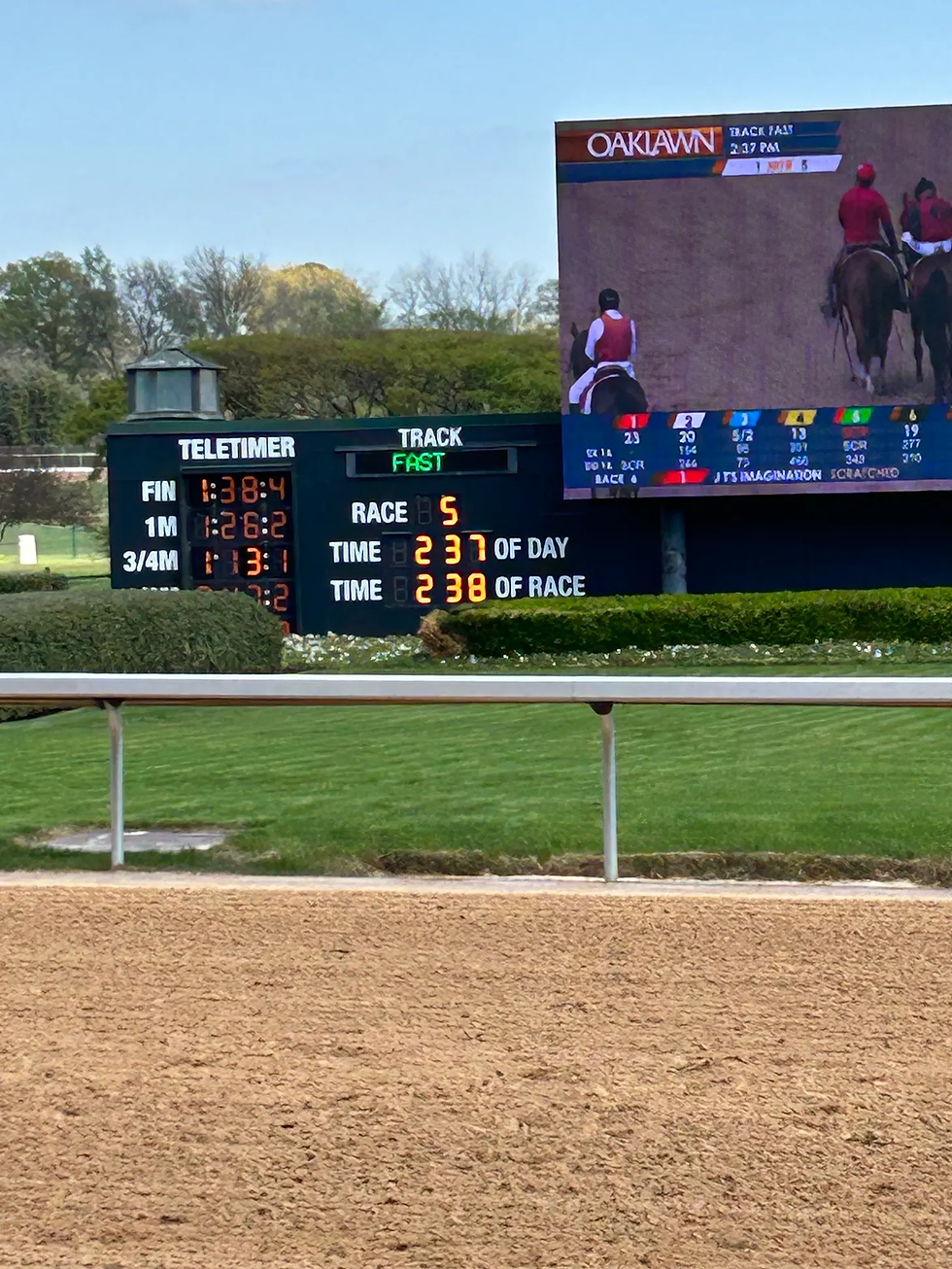
On the way out, I hit the casino floor to slots dinging and roulette wheels spinning like the mob never left. Drank nothing stronger than ginger ale. Won a little at blackjack. The whole place reeked of the old days but in a shiny modern package. Oaklawn opened in 1905, right after the first track burned. Gangsters bet here while soaking next door. The violent glamour had now been commoditized and regulated. I walked out richer by four hundred and without fear of retribution, the mountains dark against the neon. A vulture with two good wings stood guard atop the entrance sign outside, watching the horses thunder and the lights.
Saturday. Check-out day. I sat on the Arlington lawn at dawn with my coffee and journal in lap. Sun broke over the magnolias and warmed my face. Some semblance of peace had settled. My bones felt less brittle, knotted sinew in my neck and shoulders had loosened, my head was less loud. The feeling was one I was doubtful as hell that I could keep but one I was willing to fight to hold on to. The bottle still whispered from the car and all the bars that lined the streets. The past still clawed. But the springs, the hills, the people… they burrowed like a tick in the form of a new willfulness into my skin.
While I pondered how to encapsulate this week into words, a man sat down on the cast-iron bench beside me. Wayward poet, he said, dirty brown beard, stone-blue eyes piercing and darting like he’d read every book worth reading. He wore a wide-brimmed hat and bore the look of a modern—but younger—Whitman.
“You came for the same reason I did,” he said rather than questioned, voice warm as the water, speaking to me like we’d known each other since birth. We talked for hours, shared the similar wreckage we’d left behind us, the roads that led us here, the willingness to try one last time to let the world in without filter so that we could put it into words without bias; to strip the sourness from our blood so that our hearts could sing again sweetly.
“The springs don’t heal you,” he said, echoing the voices I’d heard say the same all week without his knowing. “Not till the mind says it wants to be healed. When it does… that’s when the beauty starts to trickle in. All of it. All the silver linings in the poverty and the wretched in the polish, too, the gangster’s ghosts and the vulture’s crooked flight reveal themselves and the narrow wins of horses named for pocket change feel like the were fated. Then you realize it’s all the same earth and water and we’re all made from it and we’re all so goddamned lucky to be here. Flawed. Alive. Flowing. That’s when the healing comes. Drink it all in when it does. Every fucking drop of it.”

He spoke of writing like a sacrament, of how despair can act as a fuel or lubrication if you didn’t let it burn you down. His wisdom cut clean. I laughed with him, came to tears, and forgot all about my troubled past while peace solidified in me like clay in Jim’s kiln. When he stood to leave, I shook his hand like an old friend you think you’ll never see again then turned away for just a moment to glance at the mountains. Forgetting to ask his name I whipped back quickly to call for him, but, like the vapors and ghosts that rise in this town, he was gone with no trace.
At a loss, I looked down. Saw the time on my watch. My notebook. A chaos of blue ink that veered off the lines. The entire conversation, word for word, in my own frantic scrawl. Pages filled in a trance that ran unbroken for nearly three hours. The poet was not a kindred stranger. I was him. He was me. Or, I suppose, the version of me this week in the springs had finally cleansed and let breathe.

I wasn’t sure if the water had fixed me. Or the awareness. Or the imagining of less hurtful days ahead. But I’d let in all that I could and to identify the primary cause seemed moot. My mind was willing to be healed. The natural beauty of life—in all of its elements good and bad and in between—absorbed into my skin like an ancient salve that lingers even after its outer residue has disappeared.
I closed the notebook. Packed the truck. Walked Bathhouse Row one more time and grabbed a burger at The Ohio Club and watched the races. Two Dollar Eddie won the Derby that afternoon by a nose, just as Clayton had foreseen. I cashed the trifecta for eight grand on my way out of town. It was enough to drive somewhere new and stake myself for a couple months.

I pointed my truck west towards sunset and some other hot springs I’d heard of in New Mexico. Adonis’s crooked wing hung in my thoughts and the scarred-but-kind voices of the town circled in my ears. Sobriety was still a gamble and lasting peace was still uncertain. But the first warm days of late March had done what they’ve done since the dawn of man. They had cracked the ground open, let the green and wild-petaled things push through the rot. Hot Springs had done what it has done for generations, too; removed the sick and brought something pure and steaming to the surface to be lit and be seen.
And that was all I could ask for. To have a glimmer of hope… to want to be alive again... to be damned but capable of absolution… to have a story worth telling.


Comments