The Crow Flies North

A short story of escape, survival, and unburdening.
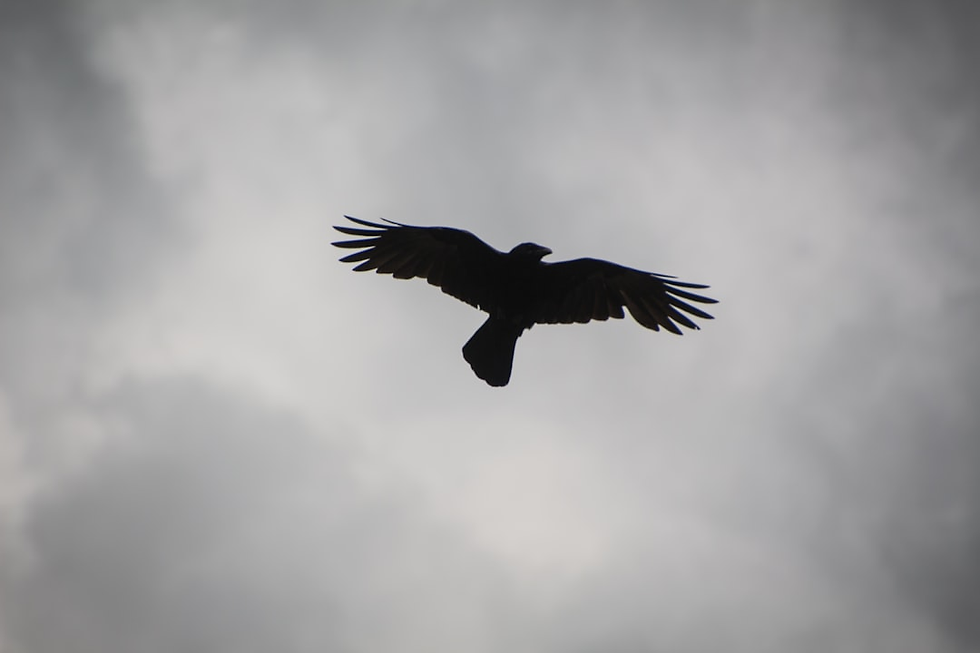
North, he walks. Sun to his left, falling over Georgia like a weary eyelid. He leaves behind a city, a woman, and a child whom he loves but who do not love him back. He travels forward without the regret and guilt he shouldered for a decade, following a path—and a bird—back toward a beginning that left grisly scars across his cheek and brow: cruel brandings placed there by the rusted edge of the coal shovel his father brought home the night the mine was shut down for good. The same implement that turned the dirt he buried his father beneath, and the same that stands wedged as the lone marker of his hidden Appalachian grave.
The last ten years have passed in fragments, marked in departures and tragedies rather than days of celebration. That twenty-second birthday was the last he observed joyously, the final one where he lived in a place long enough to be named. Since then, his boots have carried him down highways, up valleys, through half-forgotten towns and along rail lines that narrow as they stretch from nowhere toward never-will-be—past hearts and loading docks and shuttered storefronts that will never open again.
His mud-colored hair falls wildly from beneath his flat-brimmed hat and rolls off his heavy shoulders. The fraying canvas pack slung across them holds the little he is grateful to own: wool socks, clean britches, worn Levi’s, two cans of beans, a quart cast-iron cookpot, a half-sack of rice, coffee and jerky, a metal cup and spoon, loose tobacco and papers, his grandfather’s harmonica, spare bootlaces, a patinaed 1911 pistol with a dozen rounds, and a ragged copy of You Can’t Go Home Again.
Long ago, in Savannah, the lone woman he’s ever loved—and who loved him in return—told him his eyes were haint blue, same as the ceiling above her front door on Abercorn Street. The next morning, he hopped the first westbound railcar he could catch, hiding them, tears welling, as the city slid away. He wandered and rode for weeks until he reached the other ocean. All the way, he carried the horrid stare of her amber eyes, the sound of a man’s skull fracturing beneath his trembling hands, and the final wheezing breaths—thin and wet—like a dog he’d once knelt beside and soothed in death, struck down in that very same city.
Nine years have passed since that night. Train cars carrying him east and west and north and south across a country in decay, iron clacking away the miles beneath him, the harmonica’s whistle carving brief melodies to break the silence of his pain.
He lingered for a time in Oregon and Washington, hooking on to a timber crew that paid in cash and roomed him in cheap motels that always smelled of sawdust and old cigar smoke. The work was good for a hiding man with a broken soul and made use of his strength and the lumbering skills his father taught him. Among hard men with violent pasts, all running or concealing themselves from authority, he felt, for the first time unjudged, that he fit somewhere. That sense never lasted. For men like them it rarely did.
He’s seen eight buck moons hang over him since the night outside a Tacoma dive bar that left two men dead at the end of his pistol barrel—one shot through the throat, the other an inch above the left eye. Though it had been necessary to his survival, same as the first two men who died by his hands, it brought him no peace.
In evasion, he steered south, marching and hitching long stretches of the coastal highway. In northern California, a stray mutt took a liking and began to follow. On a rainy night in the cool hills of Humboldt County, she nuzzled up against him beneath a towering spruce and brought warmth he’d long forgotten. She licked his cheek, and he named her Savannah.
On ticked another year. Nights of sheeting rain and nights of curtained snow that hid him in travel. On rare nights of cloudless skies, he’d stare off at flickering candles that warmed and lit faraway worlds he imagined to be much kinder than this one.
In Wyoming, the crystalline dusk nearly convinced him such a world existed. Of all the places he had laid his head, it was the sprawling ranch near Cody that held the most wonder. Against a Rocky Mountain backdrop, he found refuge with a crew of rough-edged men, hunting wolves, mending fences, and tasting the closest thing to freedom he had ever known as he relearned the language of horses and watched bald eagles glide the rivers and lift fish from the water with ancient grace. The days stood open to him like the immense range before him, and again a woman looked into his eyes, this time comparing them not to a color that guarded against evil spirits but to the calm of a spring sky.
With another year gone, he lay beneath the Wyoming stars with the girl, barely eighteen, who would sneak in after dusk, light faded, and beyond her father’s view to be with him. On a warm morning in May, he awoke to the double barrels of the rancher’s birdgun an inch from his eyes, along with a promise that held no doubt the man would follow through on if he returned.
Keen on the mountain views and thin air, he rode rails into Denver with Savannah at his side. The tent cities of madmen and madwomen scabbed the parks like sores, and the stench of their rot made him nauseous. All around smelled of slow death and quit life. A month turned to six as he busked the corners and parks with his dog and harmonica and befriended a woman named Violet. On a frost-coated autumn night, it was she who stitched the stab wound in his side and put that first, warm, hooking needle into his vein to numb the pain. The winter passed in blurs of desperation and shades of black, and a resurgence of violent memories of his youth.
Five years have passed since he awoke from that frigid, dark nightmare. Strung out and penniless, he climbed into a boxcar and slept, not caring where it took him as he convulsed and trembled in withdrawal. Three days later, ribs showing and parched, Savannah whined him awake. The first sign he saw against the red desert scene read Sedona.
They drifted for weeks until an old hippie with darting eyes and a belt-length beard urged them aboard his sputtering, dust-caked VW bus, which was nearly as old as he. The commune they arrived at held the disillusioned and rejected of every shade and from every corner of the world. The old man told him that all here is shared and none is darkly hidden. The ragged inhabitants welcomed the emaciated pair into their tin shanties and long rooted and untowable Airstreams. The place was kind but defeated, and the outcasts talked much of change but worked toward none of it. Guns and harsh words were strictly outlawed.
A year after his departure from Denver, the paranoid preacher of the lost town, who had long suspected the drifter and his dog of being agents of Satan, discovered his pistol and the journal he kept hidden in the steel box beneath his cot. Upon reading his admitted sins to find his suspicions confirmed, he called the town elders to council. After rendering a quick judgment for exile, the man was told he was to be stripped of all belongings, including his dog, and taken to the city by the old hippie in the morning. That night, while the town slept, he escaped the poorly built cage, loaded his pack and the dog into the VW, and drove without light into the night beneath the watchful gaze of the Pleiades.
Since that night, he’s rarely stayed in any one zip code for more than a week. He walked in Texas for a few months after the VW bus finally choked to a stop. Then it was back to hopped trains and shoe leather, which led him to an alley guarded by hundreds of cats in a forgotten part of New Orleans, where an ancient, blind voodoo queen wove and spun her spells. He would not have ventured down that dark lane if Savannah had not bolted toward the exotic, stewing scent billowing from the gap in the half-hinged door. Cats hissed and leaped as he gave chase, hollering country curses at the hound. Thankfully, the broken door was barred tightly from the inside and kept the starving dog from barging in, but the fracas had already roused the old witch’s attention.
To his surprise, she greeted them eagerly, a milky-eyed skeleton with ashen dark skin, draped in a dark crimson, satin robe. Upright, she stood only to his sternum and a full two feet of cloud-white hair coiled like thin metal springs at her feet. Her voice was sharp and shrill, but motherly, with a subdued French lineage. After a heartful series of apologies, which she graciously accepted and forgave, she ushered them in under the pretense of feeding the hungry dog.
He walked in at sunset and walked out as it rose again, her parting words to him about a crow without wings trying to find sense in his pounding head. A violent pink sky shouted warning to him and the sailors undocking their ships. He sat on the corner at the alley exit, breathing refinery vapor and the smoke from hand-rolled cigarettes till midday, the dog at his feet, both their stares a thousand yards deep and their minds reeling from the medicines she imbued in them and the poisons she’d extracted.
A week later, he sat nervously clutching the hand-whittled cypress cross she’d given him as the overheating Chevy van gurgled on the highway berm outside St. Louis. The men fighting steam beneath the open hood were a trio of brothers, jazz musicians from Chicago who’d heard the somber wailing of his harmonica and the breeze-blown melody from the chimes of The Singing Oak a few nights prior. With a string of gigs lined up on their way back home and an offer of escape, he was in no position to turn it down.
The nights along the Mississippi River calmed him, and the revelry of the smoky bars brought an energy more electric than any he’d ever felt, and the virtues of the lawless people reminded him of those from the blue ridges where he was born. With a couple of nights in a warm bed, a clean shave, haircut, and a fresh set of thrift store threads, he rolled into Chicago a different man than he had been nearly six years earlier, when he was first running west.
The summer air in Chicago’s aftersun hours was a rolling parade of global aroma and noise. A nearby fire siren blared over a police siren in the distance, both echoing through the hazy, thick, diesel-fumed ether. The music of a dozen dialects poured through speakers and out rolled-down windows of the passing taxis. A train line a few blocks down rattled with metallic staccato, like an unmuffled machine gun.
Though he lived and wandered mostly in silence and solitude, nights like these brought no sense of fear or of not belonging. Here it seemed few cared about the wild look he wore, stared at his hard edges, or asked about the scars on his face. Few brought up the past, and most sought with tenacity a future unwritten by men buried long ago beneath dirt or macadam.
He would’ve stayed in Chicago forever if he could have. However, in less than two weeks, he found himself again waking to violence and threat brought forth by an evening tryst with a young woman who was drawn to his scars, this time, not her father, but her irate Russian husband who found the strange hotel room key in her purse.
He would’ve died in Chicago if it hadn’t been for the hotel maid a floor below who heard the beating and shouting begin. He was told plainly by the police officers who cut the attack short that the man whose wife he’d fucked was one of the last men in Chicago whose wife you should fuck. Unless he was as capable at hiding as an arctic fox is in snow, they reckoned a man with eyes and scars as recognizable as his had only days, maybe hours, before that crazy Russian bastard or his men would find him to finish the job.
The cops asked if he had anywhere he could go, and where his home was.
“Nowhere”, he said.
They asked if there was anyone he could trust or anyone he could call.
“No one”, he said.
One of the cops got up and left after the questioning concluded, but the other paused and lingered. He took note of the man’s few belongings and asked if that was all he had, and he confirmed it was.
“And a dog, too”, he said, “a half-dozen rooms down the hall bein’ watched over by an ol’ lady.”
The cop smiled and nodded, then took his notepad, scratched a name and address, and handed it to him. He said his brother was a truck driver, leaving for Pittsburgh in the morning. He said the Russian had killed his wife’s uncle ten years ago. Lastly, he told him good luck.
He slept along the river beneath rusting bridge girders that had long ago seen their last coat of mustard-yellow paint. At night he dreamt vividly and relived the thousand traumas he’d endured with open eyes. On the fifth morning he awoke to the dog’s whines of worry as she stood over the grey-blue body of a man, lifeless in the brackish foam of the river shore.
A week later, he stood along a different shore, this one grander, with no edge opposite in the distance. The lake was deep blue and shimmered to a horizon that blurred into the cloudless summer sky like it was painted by brushstroke. He worked his way north and east through lake towns and reached Buffalo as the days began to shorten and the air began to cool. A man there asked him where he came from. He said curtly that it was a town deep in West Virginia that sat just north of hell.
Autumn came and passed as he walked beneath a canopy of leaves that burned in shades of flame and fell dead at his feet. He snared rabbits and half-taught Savannah to tree squirrels that he picked off using the .22 caliber rifle he lifted from an abandoned hunting cabin in an upstate wildland. Days would go by without the sight or sound of mankind, as if he were a mythical creature forgotten, and when it did occur, it came and went with no more than a nod of acknowledgment of his drifting presence.
When he reached the ocean again, his beard was long and frost-frozen, and the shoreline of southern Maine stood defiant against an endless, crashing wall of liquid slate. Three days later, he heaved and rolled atop a sea that broke ships and men with equal patience aboard a mackerel hauler helmed by a captain whom the crew called “Seaballs”. His legs came to him by the second week, and he learned firsthand the reason for the captain’s moniker as he drove them through a battering storm that sunk two other, better equipped vessels. The work was as grueling as the elements, but it left no space for the shadowy thoughts that had followed and gnawed at him for years.
He spent as much time as he could at the wise captain’s side, and he learned that the old, white-bearded man could not be outdrunk, and that he could weave stories that outlived the storms and could not be out-told. The wiry seaman claimed he once threw a mutineer overboard and that he had no fewer than five ex-wives. He said he had a thousand ghosts on land and a thousand more at sea, but that the ones from land never followed him all the way out here, and the ones out here sank straight to the seafloor or deeper.
Three years have passed since the night he was pulled near-dead from the cold Atlantic waters. Although the search was honest, all who knew the captain, his sixth and current wife included, knew there was no other fate for him than to go down and sleep forever on the bed of the ocean with his ship.
For the months he’d spent mostly at sea, it was the captain’s kind wife who’d kept watch over the hazy-eyed, silver-faced mutt. When he packed to leave, he saw in both their eyes a sad contentment and a bond that could only form between two of an exceedingly rare kind of woman. He saw in their eyes a fading light, and he kissed both of their foreheads and held back the welled pools in his own as he said goodbye.
He choked back tears and dark thoughts for days as he rode a train west, the same as he did six years prior, as the whistle rang and the linkage clanked on the train that left Savannah. He vowed never again to see an ocean city on the eastern coast or take on another stray.
He was taken on a few weeks later, in the pneumonia-inducing rain, by a caravan of carnival gypsies heading south out of Cincinnati. From the warming tail of spring through the nipping start of fall, he watched townsfolk across the South and Midwest circle the dusty midways with careless smiles as rides screeched and glittered with cheap lights that flickered like dying stars. Each week, a new fairground came and the last one was forgotten until the final town arrived, and he was again on his own and back in a colder, less hopeful October rain in the Queen City.
With close to $3,000 stowed away from the summer labor and the skim he took running rigged carnival games, he headed south again to escape the coming winter. When he reached Knoxville, he made a phone call to the home of the captain’s wife to offer what he could for kibble and boarding of the dog he sorely missed. The girl who answered thanked him, then offered her own somber condolences. She told him that she had passed gently in her sleep only four days prior, and the dog who slept at her side followed her heavenward the next sunrise. The girl told him they were laid to rest together, inseparable as they had been in the wake of her husband’s death.
He took the girl’s name and learned she was the woman’s niece. After telling her of his strange relation to both, he troubled her with a request, which she warmly said she would oblige. An hour later, he sealed the envelope that held the request in written form and $2,500 to fulfill it.
He roamed and panhandled, playing his harmonica with a painful wail through the yuppie-filled streets of Nashville, then along the Walnut Street Bridge in Chattanooga, then down the heart of Alabama--first Huntsville, then Birmingham--and found himself playing to a crowd on the steps of a Baptist church on Dexter Avenue in Montgomery. A few nights here and a few nights there, and he kept moving.
Two years ago, he sat half-drunk in an Atlanta train station when his eyes again met those of the woman who had described his so lovingly seven years earlier in the Savannah dusk. With her was a young boy, strongly built, with dirty-blonde hair and eyes much the same as his. Accompanying both was a man who wore a ring, a shade of yellow gold that matched her wedding band. The keen look of fear she quickly composed into a wordless begging told him the man she had married was not the boy’s father. They walked past him quickly, she on tiptoes as if crossing a minefield, and he watched them as they walked onto the train. She did not look back at him. He stood there for hours, long after theirs and three dozen other trains had passed, until the station was quiet in its midnight lull.
When he tried to walk again, he felt as if the blood and bones of his body had been replaced by a river of iron and heavy rods of steel. The weight of regret cannot be measured, but of all encumbrances to men, there is none known to be heavier. The memory of his goodbye to her poured from his mind and held him anchored to the station bench. He sat wide-eyed and chained catatonically until dawn came and his bitten tongue bled the taste of coal dust and iron.
As he leaned to the ticket counter, he found he hadn’t thought of his destination. He asked the agent when the next train to Savannah left. She told him it would be about two hours. He then asked for a ticket on the first train going west. When Memphis came, he was told it was his stop, but he did not recall choosing it or any of the last nine hours, and as he went to stand, the empty bottle of rye that fell from his lap clanked loudly in explanation of his lost memory.
He drummed the image of his lost love’s frightened look and the boy’s resemblance to himself. Then he recalled the line of bars along Beale St. where he and the jazz trio had moaned their blues and drunk their memories away just two springs before. He found no faces he remembered there, but a few remembered his. By the time he rode further west again a few weeks later, all remembrance of him in that city would be forever rotten.
In Fayetteville, he set fire to his shirtsleeves to see if he could still feel anything. Then crossed Oklahoma and North Texas in a reckless state of self-loathing. In Santa Fe, he stole a neglected horse from a crumbling stable outside the city and rode her west until he reached Navajo lands. He gave her to a young boy named Dancing Hawk. When the boy asked for his name, the old voodoo queen’s parting words were the first to jump forth from his memory and he muttered, “Walking Crow”.
One of the elders of the reservation took note of his scars, the lifetime of agony in his eyes, and the reek of alcohol on his breath. As a thank you for the horse, he offered the man the chance to partake in the healing powers of the azee. The elder told the man he could sense the heavy yoke of the evil spirits haunting him, and that the azee, or peyote, as he later learned, would allow him to face them and be guided by his spirit animal back to himself. With nothing to lose, he imbibed.
The night was cloudless, and the ceremony took place under a moon that hung in a thin crescent of bone. For moments, he felt himself blooming black-winged among the stars, without root and unbound by gravity to this sordid world. Each time he climbed upward, he would fall back with the weight and speed of iron, then be thrust into the sky again. He saw all he had ever hurt, all who hurt him, and all in his lineage including the son he did not deserve to know. He felt again his father’s violent hands and saw the gory, crimson-dripping edge of the shovel, and the spray of blood against dark stone. He did not know when dawn came that it was truly dawn. All sense of time had left him, and he could not say if a day, or year, or decade had passed. As the effects of the medicine slowly waned, he was tended to by the quiet wives of the elders. Emptied and natal, he fell blissfully from the stars one final time and into a peaceful sleep for the first time in his thirty years. The slumber was coma-like and lasted from dawn until dusk the following day.
He stayed with the tribe through winter and into the spring and journeyed to the stars and back a handful more times, reliving his worst moments until the only scars that remained were skin deep and held no more self-pity. The sign for him to leave came subtly as he watched a crow leave its perch and land along the road. He watched as it walked west into an orange horizon without the need for its oil-slick wings.
A year ago he began walking after the onyx-feathered bird into the sunset. He trailed it first to the California coastline, and then north until he reached the huge Sitka spruce that had sheltered him and Savannah on the night she first curled up against him. He dreamt fondly of her that night and, in the morning, found himself tracking the walking bird east. He saw again, without incident, the open range and dusk skies of Wyoming, heard the howling of the wolves, and fully tasted the remorseless freedom he had once come close to there. Across the country eastward, he zigzagged, following tridactyl footprints and fallen black feathers back through towns and cities he’d seen mostly from the opposite direction and in a fogged or busted state.
In Chicago, he played one night in a dim-lit speakeasy with the brothers who’d once rescued him in New Orleans. Next, he was led to the woman who’d nearly gotten him killed and found her husband had been shot between the eyes a few months prior, by a truck driver whom he suspected he knew. He spent the night with her in the same room they had before, and in the morning, she woke beside him, smiling. When he left, she said nothing harsh, only that she had known men like him before, and they always mistook movement for change.
He followed it further east and crossed again dozens of bridges of Pittsburgh, then north to Lake Erie and through upstate New York. He reached the quiet fishing town in Maine on the eve of the three-year anniversary of the captain’s sinking. He looked out upon the cold, dark waters in silence as waves broke, until the crow walked on again and led him to the humble gravesite of a woman named Eleanor, a slab commemorated with a small granite carving in the dog’s likeness and a small bronze plaque that he had commissioned to bear a simple message.
As he sat in quiet remembrance, he heard the flap of wings and saw the idol that had been pulling him disappear due south. Without further thought, he marched back to town and caught the bus to the train station just in time to catch the one that would follow the coal-colored feathers of its tail.
Twenty-four hours later, he sat on a bench in the golden light of a Savannah dusk. For a moment, he imagined sitting on the bench beside the magnolias and letting the years close around him. The thought of idleness jerked his muscles into movement and he stood. When he did, he saw them, a woman, and her son, who nine years ago had been just a twinkle in his spirit-warding eyes. He read the happiness in the lines of their faces, and with it came a cathartic breath of acceptance and withdrawal. The crow watched him from the lip of the white fountain, their eyes met, and an acknowledgment formed without words that there was one place yet to travel and one burden yet to be released.
And now, the crow flies north, toward a mountain town in West Virginia that holds the final coffin nail to put to rest a lifetime of suffering and a decade of roaming. When he gets there, he knows the bird will be perched atop the marker of a grave that only he has seen.
So, north, he walks. The direction he will go after, he does not know, but he will leave from there unsaddled by guilt, unnoticed among the traffic and the settling dark, and carrying no more than he needs and only a faint memory of the weight of a hickory-handled shovel in his hands.
THE END.


Comments